The carrier operating system

Know what your loads really pay—and what’s coming for your lanes.

Your TMS doesn’t know what the load cost you. Your load board doesn’t know the truck is down Thursday. Your accountant finds out in March. Nothing you run knows what anything else knows, and the gaps are where the money goes.

Inteleri runs all of it as one system—dispatch, trucks, maintenance, compliance, billing. It knows your real cost per mile because it ran the load. And it watches what’s heading for your lanes while you can still do something about it.

See how it works $99 a truck · No setup fee · No contract
8parts of your operation
1system, one record
$99a truck, per month
Vantage · brief~9 wk lead

Port · trade-flow

Panama drought → Q3 volume squeeze → shippers push rates onto carriers

watchingmaturingactiveresolved
UpstreamCanal transit restrictions are cutting daily slots. It is in the port data—no market reaction yet.
ConnectiveTighter capacity squeezes shipper margins, so they move to push part of it onto carriers at renewal.
Your fleet12 of your Gulf ↔ Midwest contract lanes exposed · ~$0.11–0.18/mi at risk in Q3.
Now whatLock or extend those contracts before Q3 renewal talks; hold spot capacity out of the corridor.
Panama Canal Authority · Census FT900 · BTS TSI — 3 open feeds, cited
On your lanesRe-surfaces Aug 25

Illustrative brief

What it is

One system for the whole carrier. It runs the daily work—dispatch, the trucks, maintenance, safety, compliance and billing. Because it runs the work, it knows your real numbers, and it can see what is heading for the lanes you actually run. Warning early, and something to do about it.

01 / Plan & respond

See it coming. Then do something about it.

Two halves of the same job: one finds what is heading for your freight, the other turns it into a decision you can stand behind.

See what's coming

Vantage

The things that move your rates start moving months before they reach your rate con. Vantage watches them, works out which of your lanes they land on, and tells you what to do while it is still cheap to do it.

  • Sorted by when it hits you, from a month out to a year
  • Tied to the lanes you actually run, not the market average
  • Comes back when the window opens, then tells you if it was right
Plan & respond

Respond

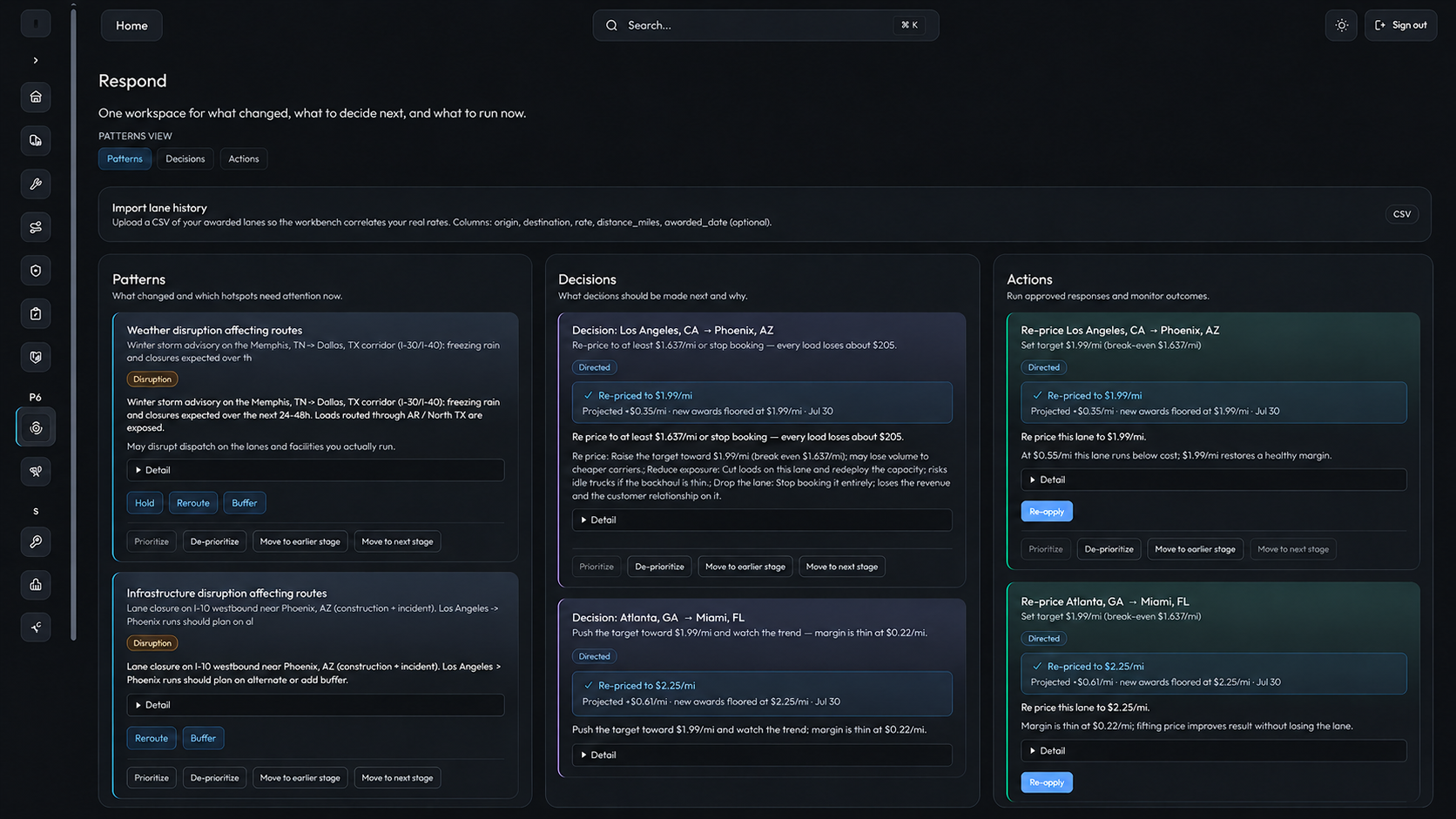
Knowing early is not the same as doing something. This is where it turns into a plain call — re-price this lane to $1.99 a mile or stop booking it, because every load is losing you $205 — laid out in three lanes: what changed, what to decide, and what to run now.

  • Every option costed, not just the one it likes: raise the rate and you may lose volume to cheaper carriers; drop the lane and you lose the customer with it
  • Nothing runs until you approve it
  • What you did and why, kept for when it is questioned
Respond in three columns. Patterns shows a winter storm advisory on the Memphis to Dallas corridor with loads through Arkansas and North Texas exposed. Decisions shows the Los Angeles to Phoenix lane: re-price to at least $1.637 a mile or stop booking, because every load loses about $205. Actions shows that lane re-priced to $1.99 a mile.
Respond, running. Sample carrier data—the layout and the numbers are the real thing.
02 / The life of a brief

A forecast that tells you when it was wrong.

Each one stays alive from the first hint to the day it lands—not an alert you read once and lose.

Stage 02 · Maturing

It reaches your lanes, with a number on it.

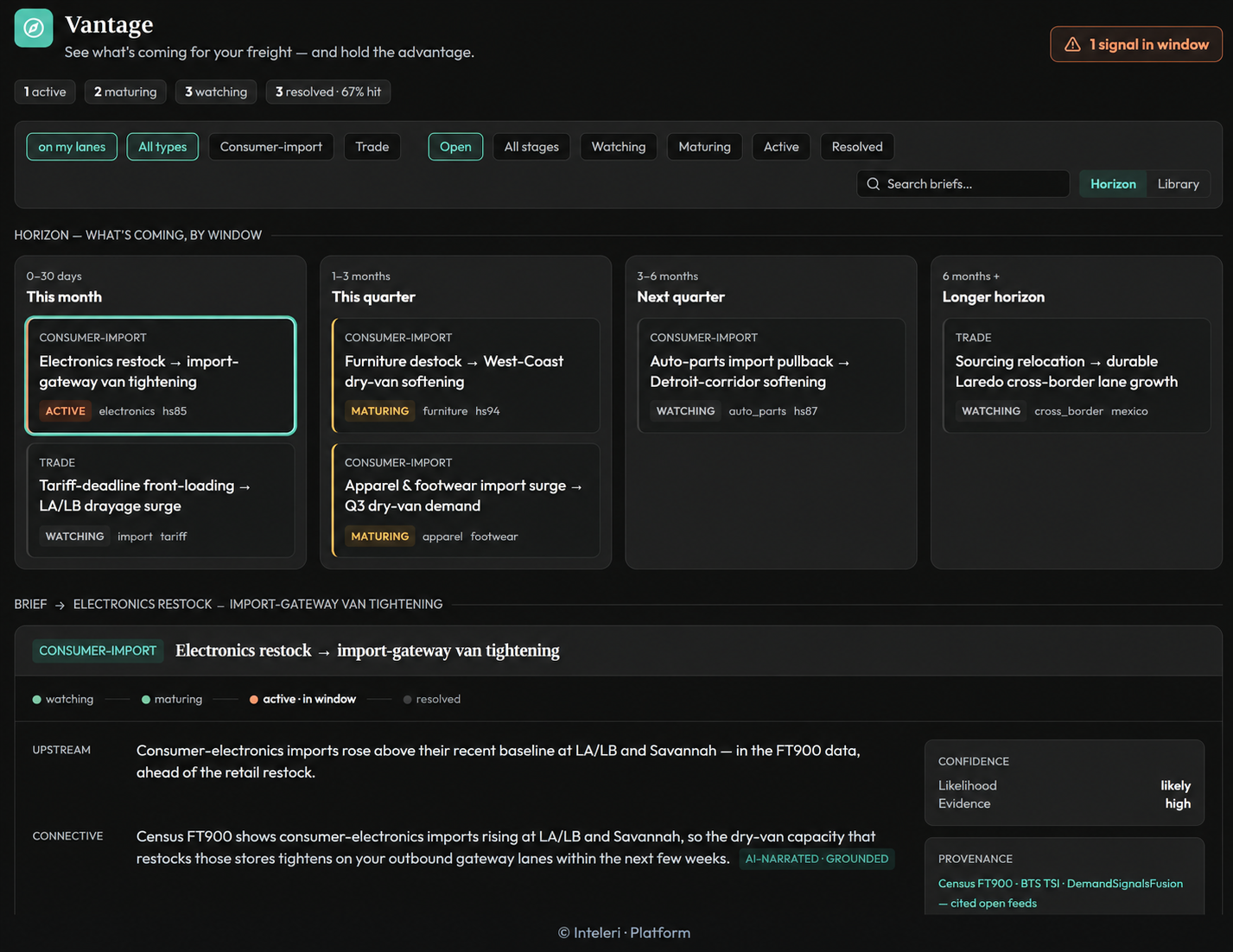
The brief follows the line from what moved to what it does to you. Twelve of your lanes. Eleven to eighteen cents a mile. Third quarter. It stops being market news and turns into your money.

12of your lanes hit
$0.11–0.18a mile at risk
Q3when it bites
Vantage, showing what is coming by window: this month, this quarter, next quarter and longer horizon. An active brief reads "Electronics restock, import-gateway van tightening", with its stage bar on active in window, the upstream reading from Census FT900 import data at LA/LB and Savannah, what it means for outbound gateway lanes in the next few weeks, likelihood likely, evidence high, and the open feeds it was drawn from.
Vantage, running. Sample carrier data—the windows, the stages and the cited sources are the real thing.
03 / The system underneath

Eight parts of the business. One system.

This is the daily work—and the reason a brief can name your lanes instead of the market’s.

OPSRun

Fleet

Trucks, trailers, drivers, who is where, and what is free tomorrow.

Drivers · equipment · schedules
OPSRun

Maintenance

Inspections, defects and work orders, so a truck does not go down mid-load.

DVIR · defects · work orders
OPSProtect

Compliance

Hours, documents, authority and state permits, kept current before they bite.

HOS · permits · authority
OPSProtect

Safety

Catch the pattern early, while it is still coaching and not a violation.

Alerts · cases · coaching
OPSCommercial

Finance

Invoices out, money in, and the paperwork to fight a shortpay.

Billing · A/R · disputes
OPSCommercial

Relationships

Who you hauled for, what they paid, and how long they took to pay it.

Customers · brokers · history
04 / Why Inteleri, not a TMS plus tools

Seven things five separate tools cannot do.

Each one written as the problem it takes off your plate.

01

You find out when it hits. Big fleets find out first.

The problemPorts, tariffs, what people are buying — the things that set your rates move months before they show up on a rate con. A big fleet pays somebody to watch them. You cannot, so every change reaches you after it is already priced in.

What Inteleri doesVantage watches them for you and follows the line all the way down to your lanes: what moved, why it travels, where it lands, what to do now. You get weeks of warning, and the public sources it came from are named.

02

Knowing early only helps if you do something

The problemOne more alert is not help. Most of these tools stop at the insight and leave you the hard part — deciding, doing it, and being able to show why you did.

What Inteleri doesRespond puts what is coming in order of what it costs you and lays out every option with its downside attached — raise the rate and you may lose volume, drop the lane and you lose the customer on it. You pick. It keeps the record, so a decision you made in July still makes sense in November.

03

Only the system that runs your trucks knows what's coming for your lanes

The problemA market newsletter does not know your fleet. Your TMS knows your fleet and watches nothing. So a general warning shows up and you work out your own exposure by hand, on a Sunday, if you get to it at all.

What Inteleri doesInteleri runs the work — dispatch, the trucks, maintenance, compliance, billing — so it already knows your lanes and what you have committed to. That is what turns “a canal is backed up” into “twelve of your lanes, eleven to eighteen cents a mile, lock them before renewal.” The operations side is not the differentiator. It is what makes the warning yours.

04

Your data is yours, and we do not sell it

The problemMarket numbers have to come from somewhere. When a vendor hands them to you free, you are usually the product — your loads and your rates pooled into something they sell on, sometimes to the brokers bidding against you.

What Inteleri doesWe do not resell your data and we do not pool it into market intelligence somebody else profits from. No broker sees what you are running or who you are hauling for. Where we touch a load board it goes through your own seat, and what comes back is not redistributed.

05

It suggests. You decide.

The problemIn this business a wrong move is a fine, a claim, or a load you did not deliver. Software that acts on its own is a liability, not a feature.

What Inteleri doesNothing that matters runs until you say so. Every action — yours, the system’s, or something you connected — has a name on it and stays on the record. That is built into how it works, not written down as a policy somebody could change.

06

The compliance department you can't affordLive

The problemThe expensive part is not the federal rulebook every TMS knows. It is the state-by-state permit patchwork — weight-distance, oversize, trip permits, hazmat routes, IFTA. Miss one and it is a fine, an out-of-service, or your authority.

What Inteleri doesBefore you commit, Inteleri checks the route — pickup, delivery, and the states in between — against the permits you hold, and flags the gap while it is still a decision instead of a citation.

07

Built for the person doing all of it

The problemYou are the dispatcher, the compliance officer and the CFO, and there is no hour in the day to pull the picture together out of five tools that do not talk.

What Inteleri doesEvery screen answers one question: what now? It works like the analyst a small carrier cannot hire — on stopping things before they happen, not filing paperwork after.

Free tools

Some of this we just give away

No signup, no email, no trial that runs out. Nothing you type leaves your browser, and none of them hand you off to a filing service or a broker—we take no referral fee from anybody. They are meant to be worth using whether or not you ever buy anything from us.

All of them in one place ↗

05 / Pricing

Priced per truck. Nothing hidden.

You pay for trucks, not features and not logins. Every carrier gets the same system.

Trucks 1–5$99a month each
Trucks 6–15$79a month each
Trucks 16–50$59a month each

The rate drops as you add trucks—truck 20 costs less than truck 2. Growing should not cost you a penalty.

What that works out to

1 truck$99/mo
5 trucks$495/mo
10 trucks$890$89 a truck
25 trucks$1,875$75 a truck

Pre-launch pricing. This is what we plan to launch at. Design partners lock this rate for 24 months and pay nothing for the first three.

What you get

  • The whole system. Every workbench, Vantage and Respond. There is no basic version and no pro version. Splitting it up would rebuild the problem it exists to fix.
  • Everyone in your office. Your dispatcher, your bookkeeper, your drivers. We do not charge per login, because charging for seats makes people share one.
  • Moving your data. We do it, and we do not bill you for it. If your history does not come across, the system is worth less to you and to us.
  • No contract. Month to month. Leave whenever, and take your data with you.

What this does not replace

  • Your ELD. Keep the one you have. We read from it. We are not going to sell you hardware you already bought.
  • Factoring, insurance, fuel cards. Not ours. We do not take a cut of any of them and we are not paid to recommend anybody.
  • Your load board subscription. We search DAT and the others and bring results in, but you still need your own account. We are not a load board.
06 / Who it’s for—and what it isn’t

Carrier-native, and specific about the edges.

Built for

  • Fleets

    Asset-based small & mid carriers and owner-operators, operating in the US and Canada (excluding Quebec).

  • People

    The owner who signs the contracts, plus the dispatchers, safety and compliance, and finance people around them.

  • Moment

    Fleets big enough to be exposed to the market, too small to staff someone who watches it.

Running one or two trucks? Some of this is worth more to you in a year than it is today. Here is what pays from day one, and what we are still building toward.

Deliberately not

  • Not

    A broker or shipper product. Carrier-native; brokers and shippers appear only as the carrier’s counterparties.

  • Not

    A carrier, broker or freight forwarder. Software only—it holds no FMCSA operating authority and books no freight as principal.

  • Not

    A market newsletter. A brief that does not end in a decision on your lanes has not done its job.

07 / Status & honesty

Launch-stage, and specific about it.

Built

Vantage runs today—signals watched on a clock, briefs that name the public sources they came from and come back as their window nears.

Landing

Tying a brief to your specific lanes and dollars—the lane counts and cents-per-mile shown above are being wired now, ahead of design-partner previews.

Built

Sign-off and security—nothing consequential runs unapproved, every action has a name on it, and the audit trail cannot be edited after the fact.

In review

Terms, Privacy and DPA are drafts pending counsel; the platform is pre-GA and every preview on this page uses illustrative data.

08 / Straight answers

The questions you were going to ask anyway.

Do I have to sign a contract?

No. Month to month. If it is not earning its keep, cancel it and take your data with you. We are not going to hold you to three years the way the telematics companies do.

Do I have to get rid of my ELD?

No. Keep the one you already paid for. We read from it. Anyone telling a small carrier to replace working hardware is selling hardware.

Is this a load board?

No. We search the boards you already subscribe to and bring the results in next to your costs, so you can tell quickly whether a load is worth taking. You still need your own DAT or Truckstop account.

Do brokers or factoring companies pay you anything?

No. You pay us and nobody else does. We take no cut of your loads, no referral fee from a factor or an insurer, and no money from a broker. If that ever changes, it will say so right here before it changes.

Do you sell my data?

No. Your loads, your rates and your customers are yours. The market read is built from public sources and from broad patterns across carriers — never from handing your book to anybody, and never in a form that points back at you.

I only run one truck. Is this for me?

Some of it, today. What you should bid and who not to haul for pay off straight away. The market read gets better the more carriers run on it, so it is worth more to you in a year than it is now. We wrote that out properly on the owner-operator page.

What if I have no integrations set up?

It runs with none. Manual entry works. Connecting your ELD, load board and accounting adds capability, but nothing is required to operate and there is no single vendor you end up stuck with.

How does it know my rates before I have run loads on it?

You upload a CSV of the lanes you have already run — origin, destination, rate, miles — and it works against your real numbers from the first week. You do not have to run on it for six months before it is worth anything.

How long does it take to get going?

We move your history over for you and we do not bill you for it. If your loads, drivers and equipment do not come across, the system is worth less to you and to us.

What is actually built right now?

Some of it is running, some of it is landing, and the section above says which is which by name. The product is pre-launch and every screen on this page uses made-up data. We would rather you find that out here than after you have paid.

09 / Who is building this

You are talking to the person who wrote it.

Mesaye Addisu

Founder

I came to this from the operating side. I ran a small fleet for a few years and drove before that, which is mostly why I ended up working on this instead of something else. Inteleri is the software I wanted then and could not find.

I build it myself, so there is no sales team to get through. If you run a carrier operation and have opinions about what is broken, I would like to hear them—including the parts of this you think are wrong.

Professional inquiries: developer@inteleri.comLinkedIn

Pre-GA · onboarding design partners

Stop finding out last.

See it on your lanes—your trucks, what you have committed to, and what is heading for them.

  • We set it up around your lanes. Not a canned demo—your corridors, your costs, your exposure.
  • Ask the hard questions. Security, what it connects to, what is built and what is not. You get straight answers.
  • You are talking to the people building it. Inteleri is founder-built. There is no sales layer in between.
Three fields. No newsletter. I reply the same day.